
Hello everyone! The last week has been an incredibly busy composition week for me. I composed a fugue for the Symphonic overture, then revised it along with the rest of the piece. I also acquired a book from the Brandywine River Art Museum called "King Arthur." Illustrated by N.C. Wyeth. For a workshop I am doing, I am required to compose a piece (or set of pieces) inspired by the art at the Brandywine River Art Museum. I became fascinated with this specific work by N.C. Wyeth and bought the book as a result. I have 4 pictures selected which I intend to write music based on (might add a fifth if I have time). Today, I got to work on the first of these projects. So, without further adieu, let's get into this first project.
Art
The Art piece I selected looks like this:
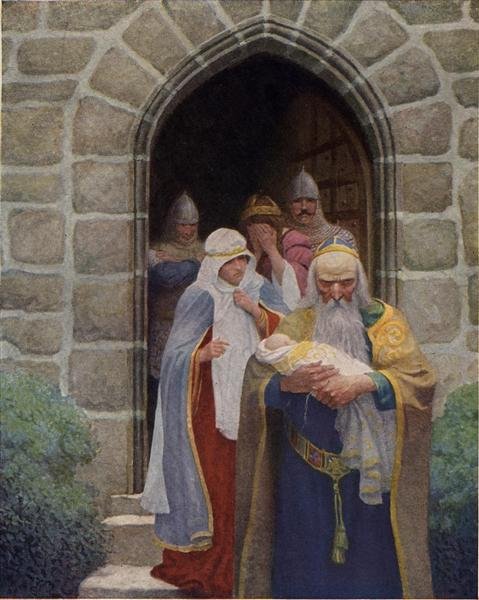
It is captioned:
"So the child was delivered unto Merlin, and so he bare it forth"
This comes quite early in the story. It develops baby Arthur into an orphan, and gets rid of the kingdom's sole heir. The people in the picture seem to be marching in line with Merlin, which is where I got the idea to make this sound kind of like a processional. I found the art to be quite impressive, and, with it serving an introductory-like role, I decided it would make a good first piece. Here is the piece:
Story
At this point in the story, we have been introduced to the king of England who has one son, Arthur. For some unspecified reason (as far as I can tell), the king decides to give Arthur to a member of the lower class, and, as a result of this decision, gives baby Arthur to two knights who, in turn, give Arthur to Merlin (the point that this painting depicts). After this, time passes and the king dies, heirless. The leaders congregate in the church and all debate each other and pray for some kind of divine sign as to who is the true heir. Upon exiting the church, they see, mounted in a stone, a sword with the inscription:
WHO SO PULLETH OUT THIS SWORD OF THIS STONE AND ANVIL, IS RIGHTWISE KING BORN OF ENGLAND.
So that's the story around this point. There is a lot that I am going to skip in these pieces because the illustrations are not frequent at all.
Composition
Form
This seems to be a classic example of Binary form with a coda. It consists of an A section which repeats with variations and a B section which also repeats with variations. This is followed by a coda leading us to our ending key of G major.
French Overture
Within this piece, I tried to use the dotted ideas prevalent in a French Overture. Paired with the fact that this is written in e minor, I hoped to subconsciously tie it to the Overture from Handel's Messiah, a quite famous British piece which also utilizes the French Overture form (not just the dotted figure) and is in e minor. I did not strictly adhere to a French Overture due to the fact that it would have led to a fugue. Instead, I created an e minor B section. I hope to incorporate a fugue later on in these pieces, but I didn't feel that a fugue would fit the characteristics within this painting. This painting seems to be somber due to the straight/sad faces of the people within it, most notably the one woman crying in the background. I thought a fugue would be too busy to depict this somber idea.
Bass Line
The A section of this piece actually utilizes the lamenting Baroque Bass line I utilized earlier this year in Erster Verlust after learning about it through the work of Bach. I sometimes revisit this Bass line when I want to depict lament because I think it is a cool way of expressing filial piety. Of course, I try to vary how I harmonically develop this bass line. I do think the lamenting idea should be present because Arthur is losing his father and any knowledge he would have had of his heritage. He is losing his identity. Luckily, Excalibur returns that identity to him.
Arthur's Theme
I like to think of the B section theme as Arthur's theme. Something interesting about this theme is I actually wrote it several years back when I had no understanding of harmony. I decided to reuse it here because it was in e minor, and I never properly developed it.
I hope to work this in in one way or another for every piece depicting Arthur. I will probably adapt it to fit his age and the mood of the painting.
Why A String Quartet?
You may be curious as to why I decided to go with a String Quartet. I decided to go with a string quartet because it is an ensemble I have not yet written for, and strings are something I am still fairly unfamiliar with. I decided that this would be the best ensemble to do for this workshop because it helps me learn the most. Plus, I have respect for string players and look forward to hearing their interpretation of my work.
Conclusion
Thanks for reading this! I apologize that I have not uploaded the next Germany article. I have been incredibly busy with composition (As I previously mentioned). I have noticed that this year I have been completing much more compositionally than I have in years past. I think I am beginning to feel more confident with my writing, and as a result, don't need to spend as much time second guessing my work. As always, however, feedback is appreciated. I realize that this is a piece that was written literally less than 12 hours ago, and there are bound to be mistakes or poor decisions. Feel free to alert me of any you notice or interpret. I am quite thankful for some of the experienced musicians/appreciative readers who this platform gives me a connection with. I hope you enjoy this piece! Thanks again, and see you next time!

(Note) In order to encourage meaningful feedback on the platform, I will check comment trails of users who leave superficial comments (ie "Awesome post," or "Upvoted.") and will mute any users who exhibit a pattern of leaving "spammy" comments.