
Hello everyone! I was extremely excited when I saw the feedback left for the first movement of this collection. And, as a result I was eager to advance my work (not as if I have a choice. A majority of it is due Monday). Anyway, let's get into this piece!
You can see the First Movement's Article Here
Art
The next painting which I decided to interpret to music was this one:
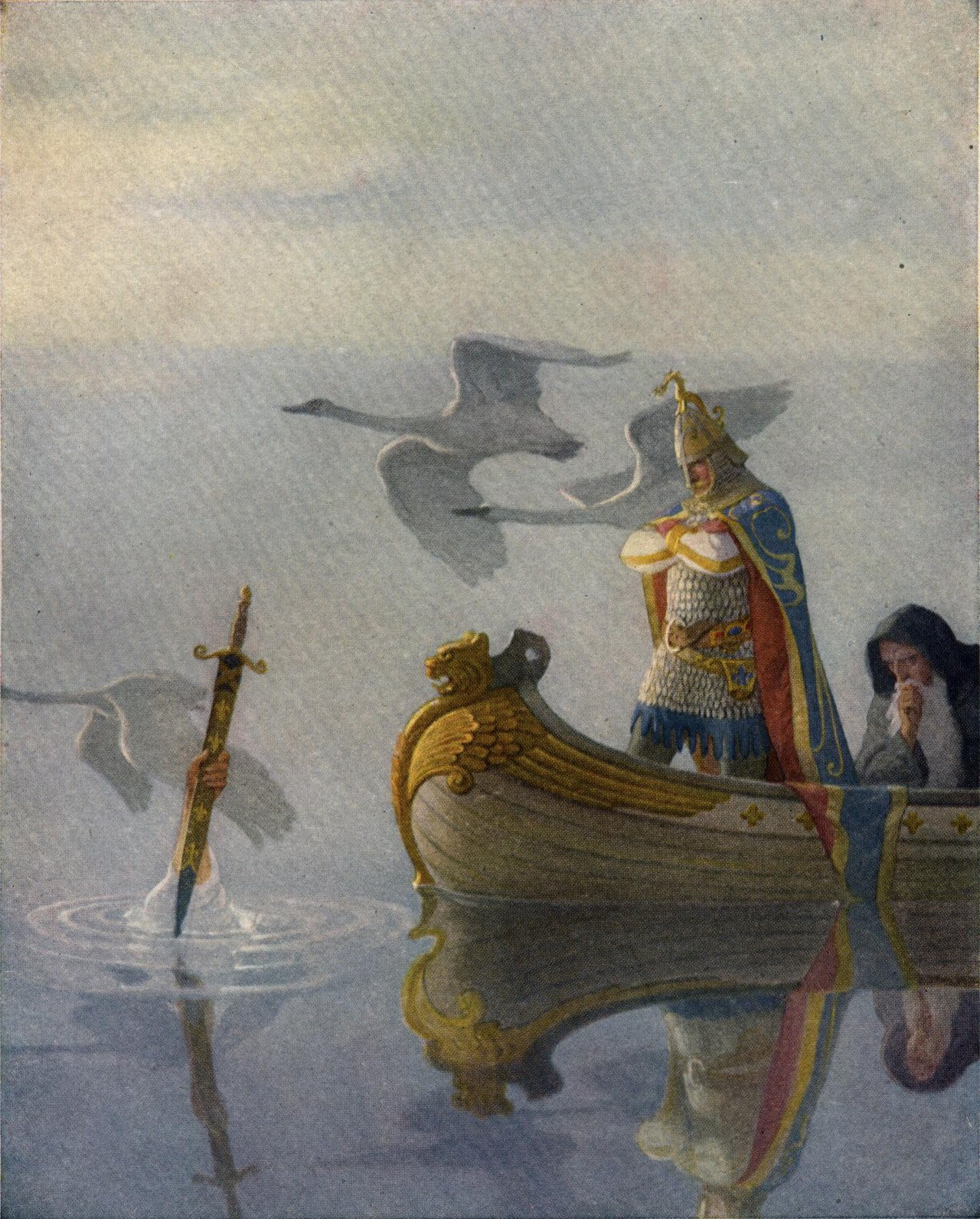
Captioned:
And when they came to the sword that the hand held, King Arthur took it up
I will get into this painting's placement in the story. But first, the actual movement. I tried to make it sound triumphantly royal, much like Handel's Water Music (more on that later). Here is the second Movement of my King Arthur String Quartet, entitled "King Arthur's Water Music:"

Story
At this point in the story, Arthur has been decided by all of the Nobles and Priests to be king. One day, a squire rode into court with his dead master on his horse. He informed Arthur that his master had died jousting a (it would seem rogue) knight in the woods. Arthur knighted this squire (upon his request) making him Sir Griflet. Arthur then ordered the new knight to go joust this rogue knight in the woods. Sir Griflet jousted the knight, and lost. However, the knight, in good faith, sent Sir Griflet, wounded, back on the horse. The surgeons managed to save him as a result.
Later, Arthur was travelling with Merlin, and he came upon this knight. Having heard about him, the king ordered the knight to leave. The knight instead challenged him to joust. The scene which followed was very much similar to this one(in sequence). The big difference being that in the book the knight Arthur duels is named Sir Pellinore. Not Sir Lancelot (who comes later). In the end of the duel, Arthur is about to lose, and Merlin puts Sir Pellinore to sleep (using magic) and forces Arthur to flee.
When they are traveling, Arthur realizes he has lost his sword. Merlin points out the lake and basically says that he knows someone who will give him a sword. Arthur asks who that is, and Merlin responds that she is the lady of the lake. Arthur then has a conversation with the lady (on land - no idea how that works). And she says that if he promises to give her a gift later on, she will let him have the sword. He agrees. So, Arthur and Merlin sail out to the sword as depicted in the painting.
Music
This movement actually wasn't originally intended (As you can see by the first post talking about an eventual 4 movements. However, one comment which I really found helpful was by @partitura, who said:
I am puzzled by the sudden ending in G major. Leaves an unfinished feel to it. I guess this part is yet to be extended? Or it is meant to feel unfinished, because of the parts that will follow it? And the sudden harmonic change will be balanced in later parts?
By this point, I had already composed what I thought would be the second movement of the intended four. However, when I saw this comment, I realized that he was right. I had made a sudden beeline towards G major in the coda of the first movement. I needed to expand on this G major.
The reason why I had strayed away from this was that I had gone back to the museum and listed all of the paintings that it actually displays (only 2 which are to come). So, I decided that I would approach the rest of the work with intentions of setting those 2 (which are displayed), on top of the Orphan one (not displayed) in the beginning, and the Death of Arthur (not displayed in the end).
I had gone to G major when I wrote the first movement (before visiting the museum) because I had intended to make this scene the second movement. But, I strayed away due to the reasons I previously stated. @partitura's comment made me realize that people were actually expecting me to expand on what I had previously alluded, so I decided to add this painting to the mix.
Form
This piece uses, yet again, a pretty simple form. That form being Rounded Binary. Thus far, I have not been extremely complex in my use of form. But, sometimes that is okay. What is most important is depicting the mood, which I hope I did well.
Mood
Though this painting seems to have a relaxed, almost tranquil look to it on first look. I thought what it is depicting is actually quite empowering. It is depicting King Arthur riding out in order to retrieve Excalibur from the Lady of the Lake. This is an actual depiction of one of the story's super natural forces showing favor towards Arthur. In my mind, this scene locks Arthur in as the one true king, and, as a result, I decided to make the music sound royally bold.
Drawn Influence
For this piece, I drew a slight amount of influence from Handel's Water music. The reason being that this music earned its nickname because it is what the king (of England) would have played as he traveled down a river (by an orchestra also travelling down the river). I thought it would be a cool reference to make by making the music sound similar since the picture is literally depicting a king (of England) in a boat travelling on a body of water.
Musical Concepts
You will notice that the A section shares a time signature with Handel's suite no. 2, and uses similar thematic figures. Of course, I also quoted Arthur's theme in the A section just to continue that little concept of using it in some fashion for the scenes that Arthur is involved in. You will notice that it is a little bit more triumphant here than it was in "The Orphan's Processional" partially because of the 3/2 time signature and the use of G major. I did this because this scene is much more grand and happy than the first (where Arthur was literally given away by his own biological father).
The B section is in 6/4 because I wanted to contrast the feeling of 3 from the A section with a feeling of 2 in the B section. The B section is also in D major (V of G and the same key as Handel's Suite no. 2 which I drew influence from [a little less for the B section though]). The B section ends by Modulating back to G Major to repeat the A section's theme one last time.
Conclusion
Thanks for reading this! As always, feedback is always appreciated! I will try to get the next movement up, but I also need to get a move on these Germany articles. So, please be patient with me. Anyway, hopefully I will see you in the next article. Have a nice day!

(Note) In order to encourage meaningful feedback on the platform, I will check comment trails of users who leave superficial comments (ie "Awesome post," or "Upvoted.") and will mute any users who exhibit a pattern of leaving "spammy" comments.